📊 SemiAnalysisSemiAnalysisDoubao · 实盘不做把握 6/10不做原因:风险收益比不佳
北京时间·🕒 发布 13:39:38·⟳ 抓取 14:01:50 +22m12s·⚡ 决策 10-19 15:51:54 +1h50m·8.2 天前
SemiAnalysis 发文重申 2027 年全球数据中心建设将加速至约 +50GW,力挺 AI 资本开支链
这是专业研究机构的行业观点和自有预测更新,方向利多 AI 数据中心资本开支链,但公开正文没有任何公司级新增订单、合同金额、指引变化或一手客户确认;关键数据在付费墙后,点名公司又是高覆盖、高拥挤的大市值供应链标的,无法证明相对当前共识存在可执行预期差。
📄 原文SemiAnalysis↗ 原文
Datacenters 2027: The Year of Acceleration, +50GW in a Single Year
Not a week goes without another piece of datacenter FUD. [We’ve already debunked depth why moratoriums aren’t as impact…
不做 Vertiv(VRT.US)
文章仅给出 AI 数据中心行业长期景气和泛化供应商受益叙事,没有 Vertiv 新增订单、客户、金额或指引上修;标的覆盖度和拥挤度高,在未核验盘前价格反应与公司级 materiality 前无明确短线 edge。
展开详情(成交明细 / 研究档案 / 原文全文 / 决策记录链)
研究档案
结论摘要
SemiAnalysis 用建设进度和约 1 万亿美元已签租赁支撑 2027 年 +50GW 的强景气判断,但该文是宏观/行业研究观点而非公司公告,未给 Vertiv、ABB、Sterling 等可交易标的的新增可核验订单或财务增量。方向明确但个股 edge 与 materiality 不足,故不做。
🔎 新鲜度:最早出现 2026-10-19 · 扩散 low · price-in 风险 medium ↗
关键理由
- 若 +50GW 与超 1 万亿美元租赁预测兑现,电力设备、冷却、模块化建造和发电 OEM 的订单能见度将获得中长期支撑。
- 文章发布仅约两小时、尚未进入美股正式交易,短期可能强化 AI 基建交易叙事,但公开部分没有公司级新增事实可锚定单只股票。
主要风险
- 该预测与市场已高度拥挤的 AI 资本开支共识同向,若盘前已高开,易变成 sell-the-news 或仅带来板块 beta。
- 文章同时承认劳动力、供应链、融资、电力和 2027-28 存储/逻辑约束,且核心明细付费化,外部投资者无法独立核验具体订单弹性。
反向证据
- 做多前查反向 · 来源 web · 日期 2026-10-19 · 影响 weakens
文章自身即讨论 FUD、劳动力、供应链延迟、融资挑战、电网约束以及 2027-28 存储和逻辑短缺;这些因素限制把行业预测直接转化为短期个股利好。
检索:datacenter oversupply 2027 constraints power labor debt memory logic shortage SemiAnalysis 原文 ↗
先例如何影响了这次决策
对本次决策的影响:先例不足与公司级增量缺失共同支持不做,而非用泛化行业乐观情绪开仓。
方向:未获得可用于校准的、由一手首发锚定的同市场同机制价格先例;仅凭研究机构看多文章本身不能推出短线胜率。
涨幅量级:缺少同主体、同市场、同相位且首发可信的高相似样本,不能据此设定止盈止损。
形态:AI 数据中心资本开支主题常与拥挤交易和高开低走风险相关,但本次未用真实日线样本验证,不能把该印象当作交易依据。
工具执行结果 · 成功 1 · 降级 0 · 失败 0 · 取消 0
- search_processed_events 成功 stock_tools HTTP · 11 ms
{"result": "search_processed_events:agent query=`semianalysis 2027 datacenter buildout 43gw 1 trillion leases | semianalysis datacenters 2027 year of acceleration 50gw | vertiv abb sterling infrastructure datacenter 2027 orders s`;结构化索引覆盖完整 72 小时;旧记录兼容扫描近 0.0/72 小时、0 条本臂决策(完整),返回 0 条候选。未命中只表示这些 agen
原文全文
展开原文 · 14,925 字
Not a week goes without another piece of datacenter FUD. [We’ve already debunked depth why moratoriums aren’t as impactful as one may think](https://newsletter.semianalysis.com/p/stop-saying-half-of-2026-us-datacenter). Despite that, many still misunderstand the pace of the global AI datacenter buildout. Just the other week, Brad Gerstner from Altimeter showed our data on the All-In Podcast and stated that “SemiAnalysis’ forecast of +43GW in 2027 is too aggressive” and that he thought only about 25GW would get built, close to half of our number, based on his “hunch”. But let’s not operate on hunches.
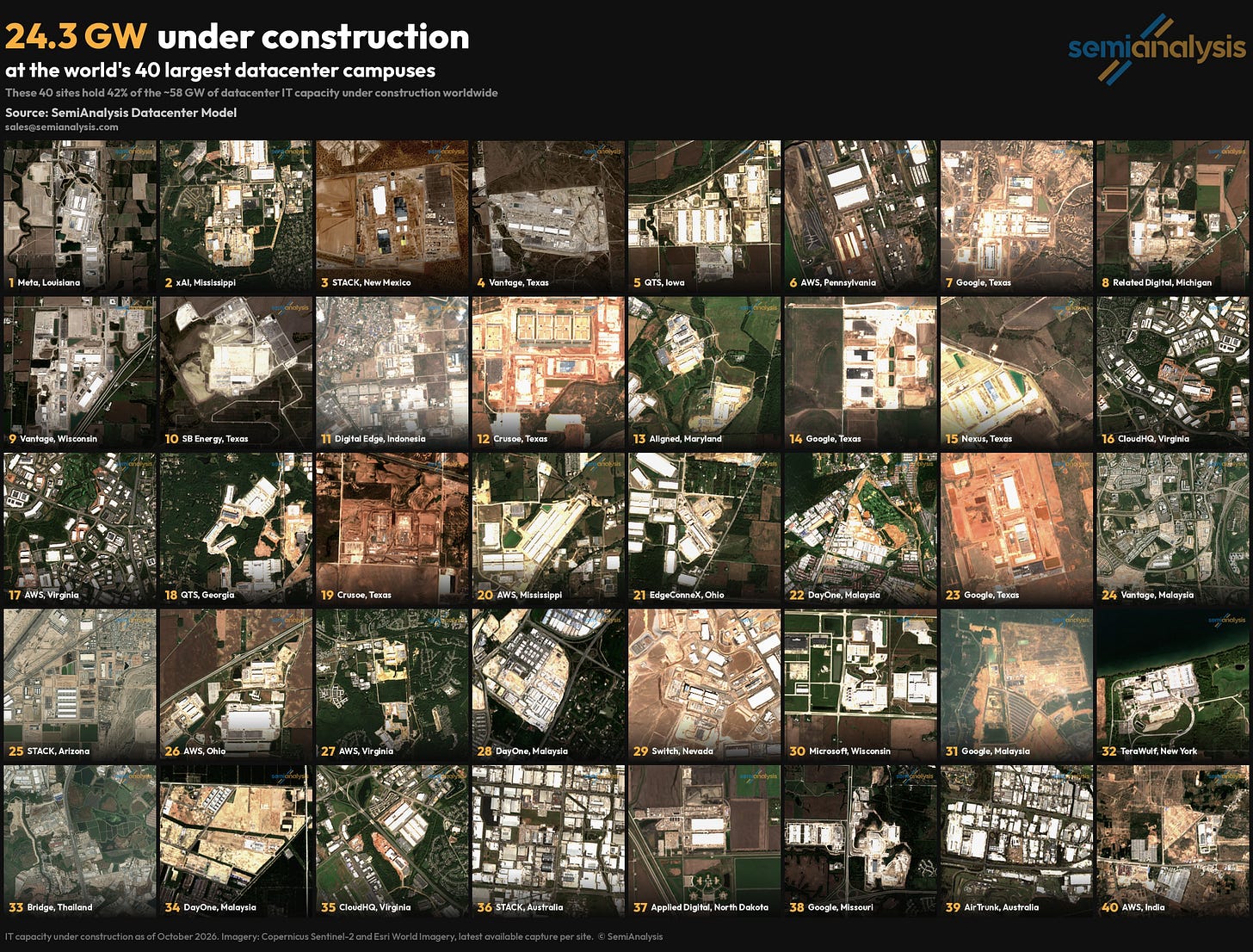
It’s very tempting to cede to the FUD given all the constraints on the datacenter buildout: power, labor, supply chains, capital, and many more. But at SemiAnalysis, we care about the truth, not about narratives. And here’s the truth for you: one picture, >24GW of datacenters in advanced stage of construction, all to be delivered in 2027. Most of them are more than halfway done, with exterior cooling and electrical equipment already installed. That’s just 40 campuses, a tiny share of the multiple hundred sites in advanced stage of construction. We track them all, and for the full granularity, use our [Datacenter Industry Model](https://semianalysis.com/datacenter-industry-model/).
_[Source: SemiAnalysis Datacenter Industry Model](https://semianalysis.com/datacenter-industry-model/)_
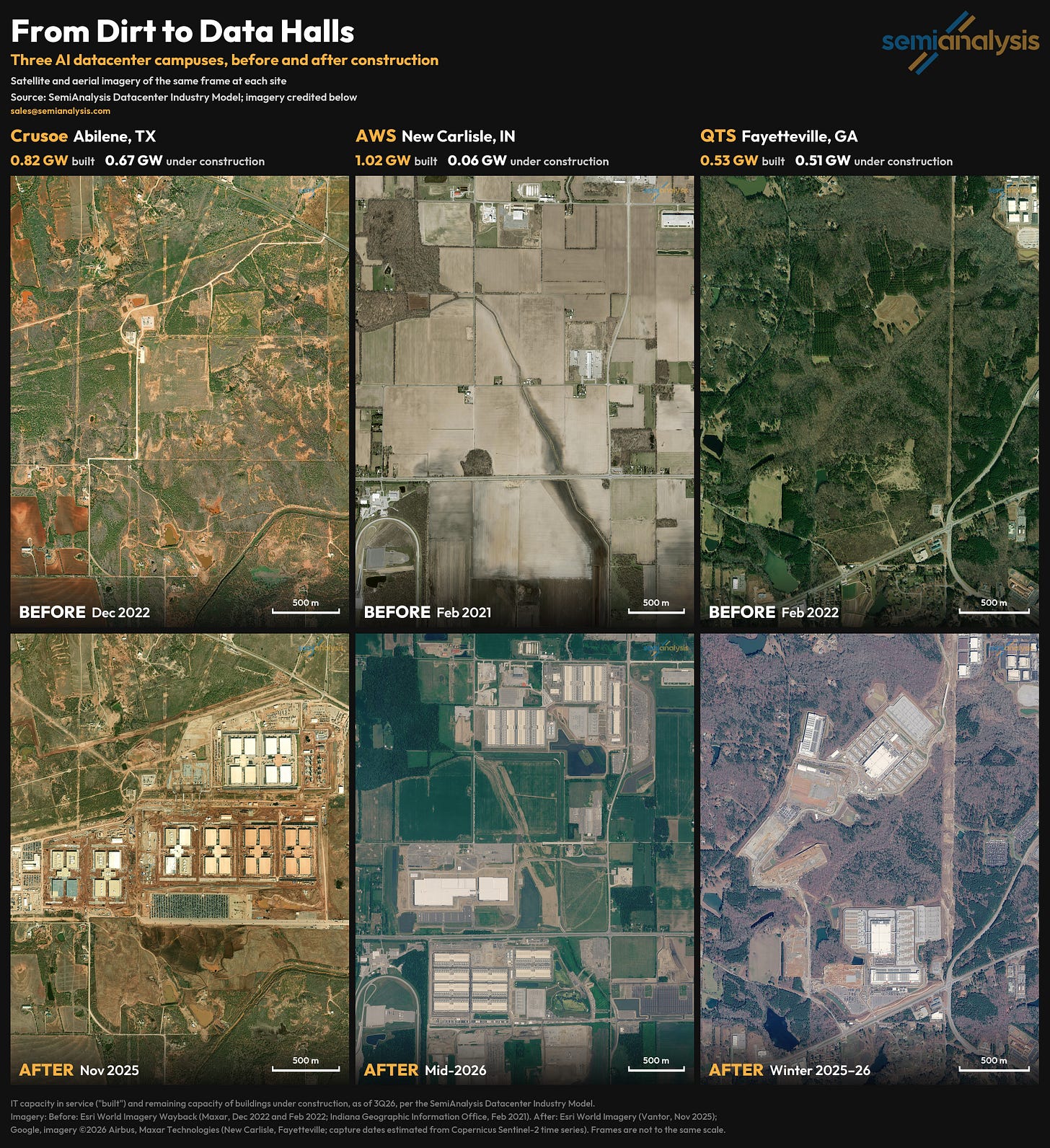
Of course, there are plenty of challenges and shortages. Behind these pictures, there are labor issues, supply chain delays, fundraising challenges, among many others. We’ve written in-depth about [Modular Datacenters and Labor](https://newsletter.semianalysis.com/p/the-wild-wild-west-of-lego-datacenters), Datacenter [Electrical](https://newsletter.semianalysis.com/p/datacenter-anatomy-part-1-electrical) systems, [Cooling](https://newsletter.semianalysis.com/p/datacenter-anatomy-part-2-cooling-systems) systems, [Behind-The-Meter power](https://newsletter.semianalysis.com/p/65b2f4e2-b298-4b11-97b1-e40721e15ee5), the [US Grid Constraints](https://newsletter.semianalysis.com/p/us-grid-constraints-towards-40gw), and [Nvidia’s ecosystem financial support](https://newsletter.semianalysis.com/p/nvidias-backstop-universe-heads-i). But the fact is simple: gigantic sites are simply getting built, and many are on time. For example, just go look at what Crusoe built in Abilene, what AWS built in Indiana, or QTS/Microsoft’s giant site in Georgia. These are the sites that have produced SOTA technology like GPT-6 and Fable 5.5. Looking ahead, despite all the constraints, an accelerating number of giant sites keep getting built, as shown by our Top 40 picture
_[Source: SemiAnalysis Datacenter Industry Model](https://semianalysis.com/datacenter-industry-model/)_
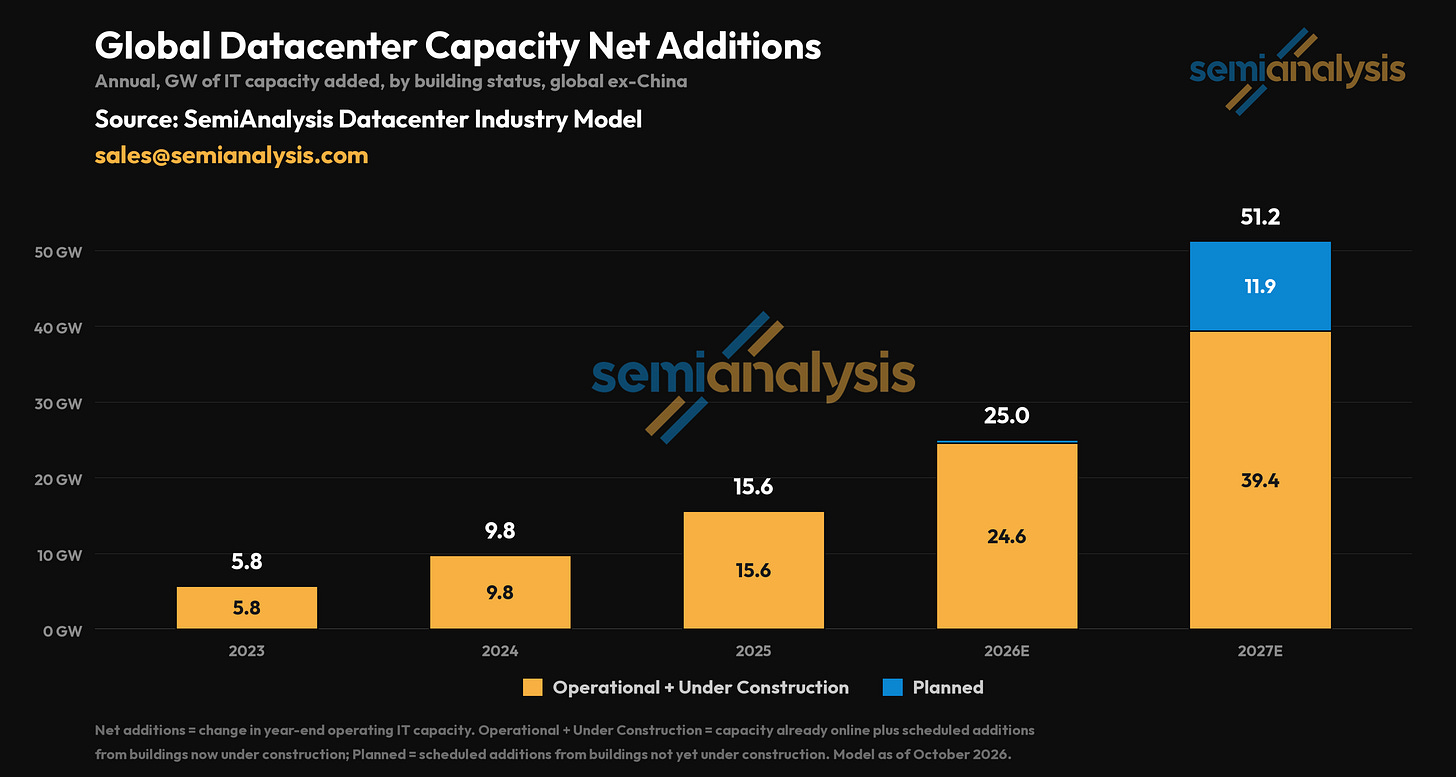
If you ask any datacenter builder, they’ll tell you how hard it is, how some workers aren’t showing up, how vendors are delayed, and many other issues. All of this is accurate. And that’s why we’ve successfully called out countless datacenter delays and keep calling out developer timelines that appear overly aggressive in our Datacenter model, including the [Oracle New Mexico Force Majure site delay in April](https://semianalysis.com/datacenter-industry-model/). To be fair, +50GW is essentially the global cumulative datacenter market up through 2024 being built in one year! But our [Datacenter Industry Model](https://semianalysis.com/datacenter-industry-model/) adjusts for all of that and still points to a material acceleration in datacenter capacity in 2027. So, what are we seeing that others can’t?
_[Source: SemiAnalysis Datacenter Industry Model](https://semianalysis.com/datacenter-industry-model/)_
SemiAnalysis is a reader-supported publication. To receive new posts and support our work, consider becoming a subscriber.
**
Let’s dig in. We’ll explore the following topics in this report:
-
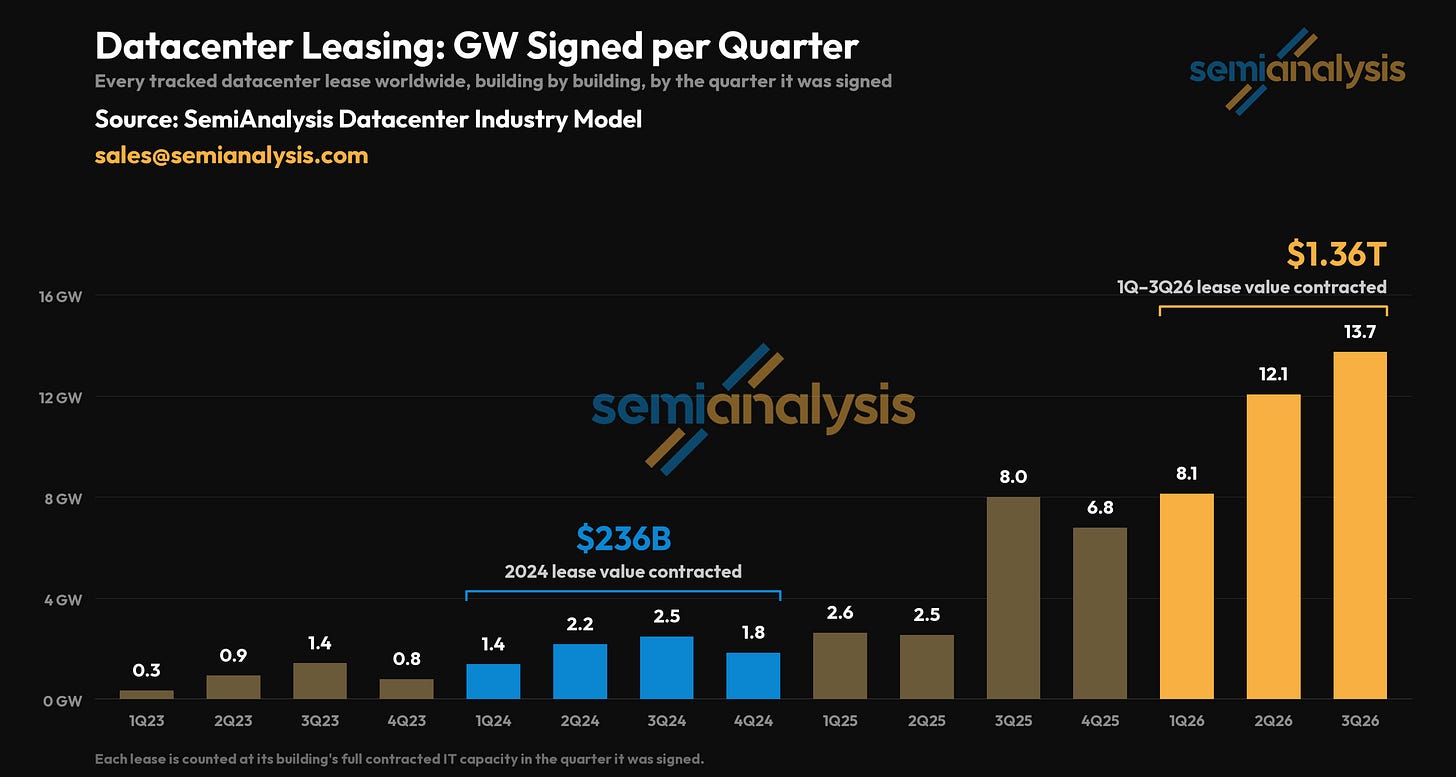
SemiAnalysis proprietary leading indicators: we’ll show a sneak peak of our proprietary data supporting our forecast, such as self-build construction starts and datacenter leasing (in MWs and USD). Year-to-date, **slightly under USD 1T of binding / non-cancellable datacenter leases have been signed** – that’s key to supporting our aggressive 2027-28 forecast.
-
The shape of the buildout: how can we support +50GW in a single year? Where, what design, what power solutions?
-
The “real” question: are we going to face a datacenter oversupply? As we explained in [The Great Silicon Shortage](https://newsletter.semianalysis.com/p/the-great-ai-silicon-shortage), datacenters & power may be the tip of the iceberg, with memory and logic possibly becoming the new #1 constraint in 2027-28.
Overall, we are very excited about 2027. The natural implication of the acceleration will be significantly more compute supply. That means cheaper and smarter AI, faster pace of AI model progress, and likely material revenue acceleration for leading AI labs and other token vendors. That also means unthinkable capex numbers. Reflexively rates will have to shoot up to enable the buildouts from a capital demand perspective. Let’s dive in!
# SemiAnalysis Datacenter Leading Indicators: how we see the buildout before everyone else
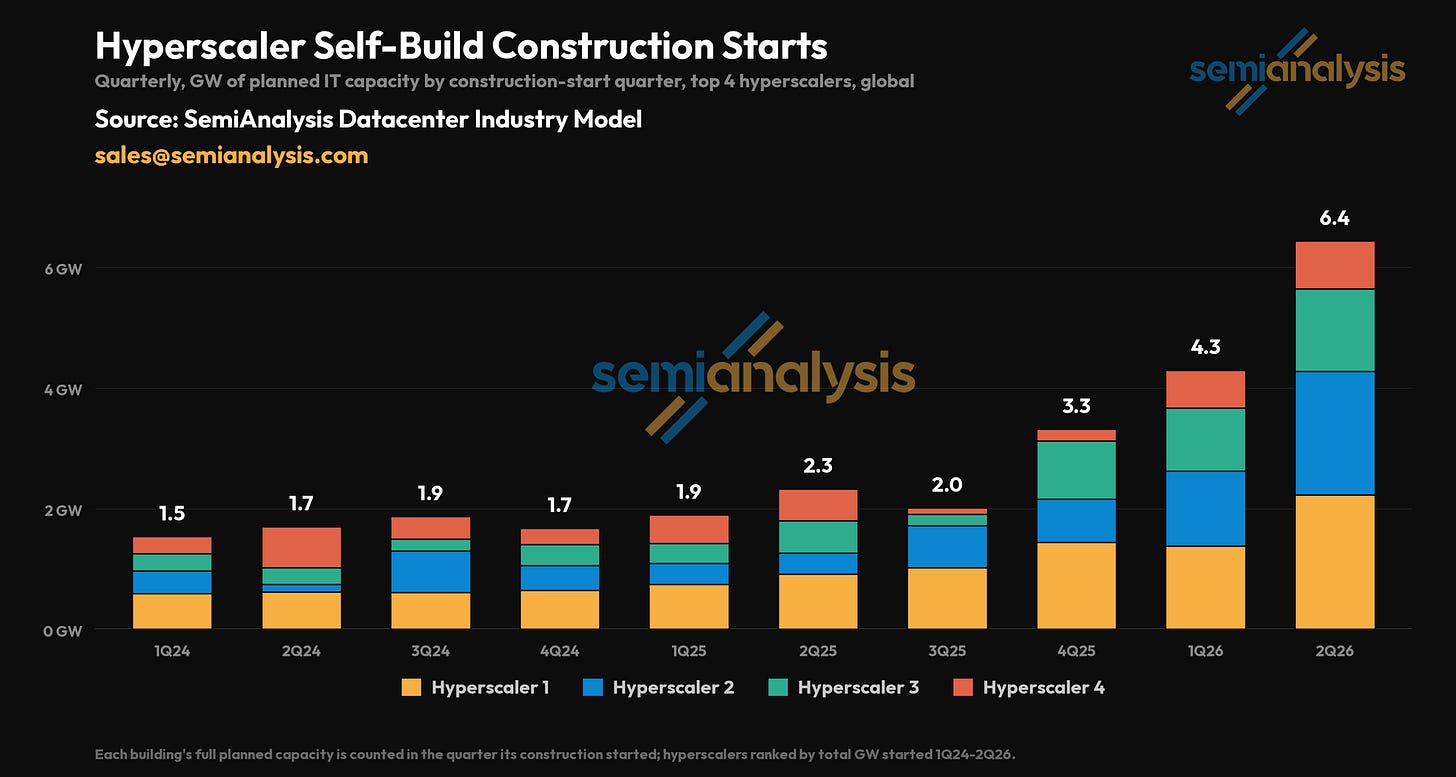
Today we want to dive into two crucial indicators that give us strong confidence on our 2027 forecast. The first one is quarterly self-build construction starts. To accurately forecast US hyperscalers, we track the exact construction evolution of every single building. And the conclusion is simple: US hyperscalers have never launched more construction of datacenters. Each quarter, we track how many MWs start construction, and that number is going parabolic, driven in particular by two hyperscalers. If you want to know who or track the granularity of our data, subscribe to our [Datacenter Industry Model.](https://semianalysis.com/datacenter-industry-model/)
_[Source: SemiAnalysis Datacenter Industry Model](https://semianalysis.com/datacenter-industry-model/)_
The second indicator is Datacenter Leasing. We’ve talked about this a lot in prior reports, but as a quick recap: given the capital-intensity of building multi hundred MW datacenters, developers typically only spend 5-10% of project capital without a customer. They need a “pre-lease” to fund and develop the whole project. That’s typically a 15-20 year contract, with a TCV of $30-50B per GW. Check out our [HPC Lease Tracker](https://semianalysis.com/datacenter-industry-model/) as part of the [Datacenter Model](https://semianalysis.com/datacenter-industry-model/) to dive into actual contract economics.
[Subscribe now](https://newsletter.semianalysis.com/subscribe?)
As such, tracking these lease contracts is a key leading indicator, as it leads debt raises, which itself leads the actual buildout. A big reason why 2026 datacenter growth isn’t “that” high relative to 2025, is that quarterly datacenter leasing remained relatively stable between H2 2023 and H1 2025. Of course, the key reason was the Microsoft Datacenter Freeze, which we called out before anyone else in December 2024 for [Datacenter model subscribers](https://semianalysis.com/datacenter-industry-model/): the Redmond giant single-handedly drove the leasing market in 2023 and 2024, then paused, and others could only pick up what was left behind.
Since H2 2025, things have dramatically changed. Oracle kicked off the era of gigantic leases, after closing on ~4.5GW of datacenter IT capacity across three sites between August and October 2025. Everyone else followed, and the pool of buyers has never been broader, with Meta, AWS, Microsoft, Google, Nvidia, AMD, Anthropic and OpenAI all being in the market for GW-scale leases. There’s also a long tail of Neoclouds signing hundred-MW-scale deals.
In USD terms, this means an unprecedented amount of lease value that builders can use to raise debt. **Just in 2026 year-to-date, we’ve identified over a trillion USD of lease value that was signed and closed**. That trillion is supporting a gigantic datacenter buildout in 2027-28. Our new [Compute, Capital & Markets Model](https://semianalysis.com/compute-capital-and-markets/) is now tracking all the debt raises and can confirm that most of this debt has been raised.
_[Source: SemiAnalysis Datacenter Industry Model](https://semianalysis.com/datacenter-industry-model/)_
# The shape of the buildout: how to build 50GW in a year
Tracking all of these leading indicators has enabled us to [forecast, before anyone else, the upcoming surge in orders for many industrial suppliers like Vertiv, ABB, Sterling Infrastructure. Check out our Industrials Model for in-depth coverage](https://semianalysis.com/industrials-model/). However, the challenge is now going from orders to delivery. And resources have obviously become constrained, as power, labor, and sheer regulatory overhead are enormous burdens for developers. But the industry has promptly reacted with innovation.
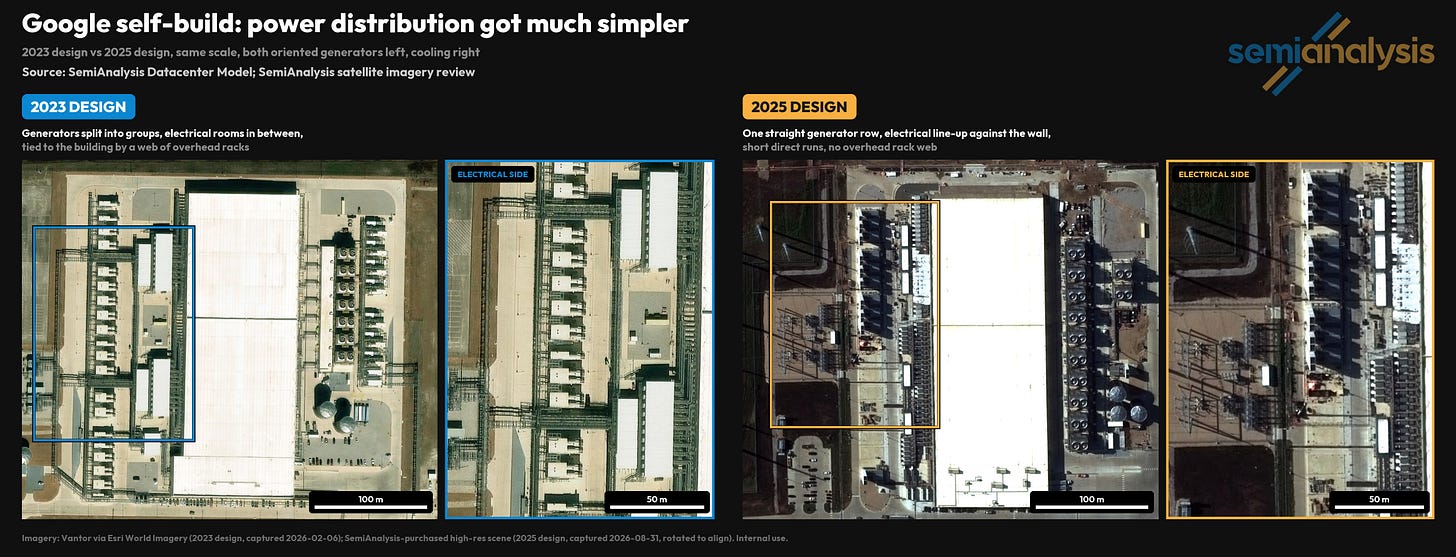
The first step is to simplify datacenter designs. We show below how Google has modularized their electrical architecture, removing a significant amount of outdoors cabling that requires onsite assembly, replacing them with prefabricated electrical modules. We track all the equipment changes (including suppliers) for datacenter designs and forecast orders in our [Industrials Model](https://semianalysis.com/industrials-model/)
_[Source: SemiAnalysis Industrials Model](https://semianalysis.com/industrials-model/)_
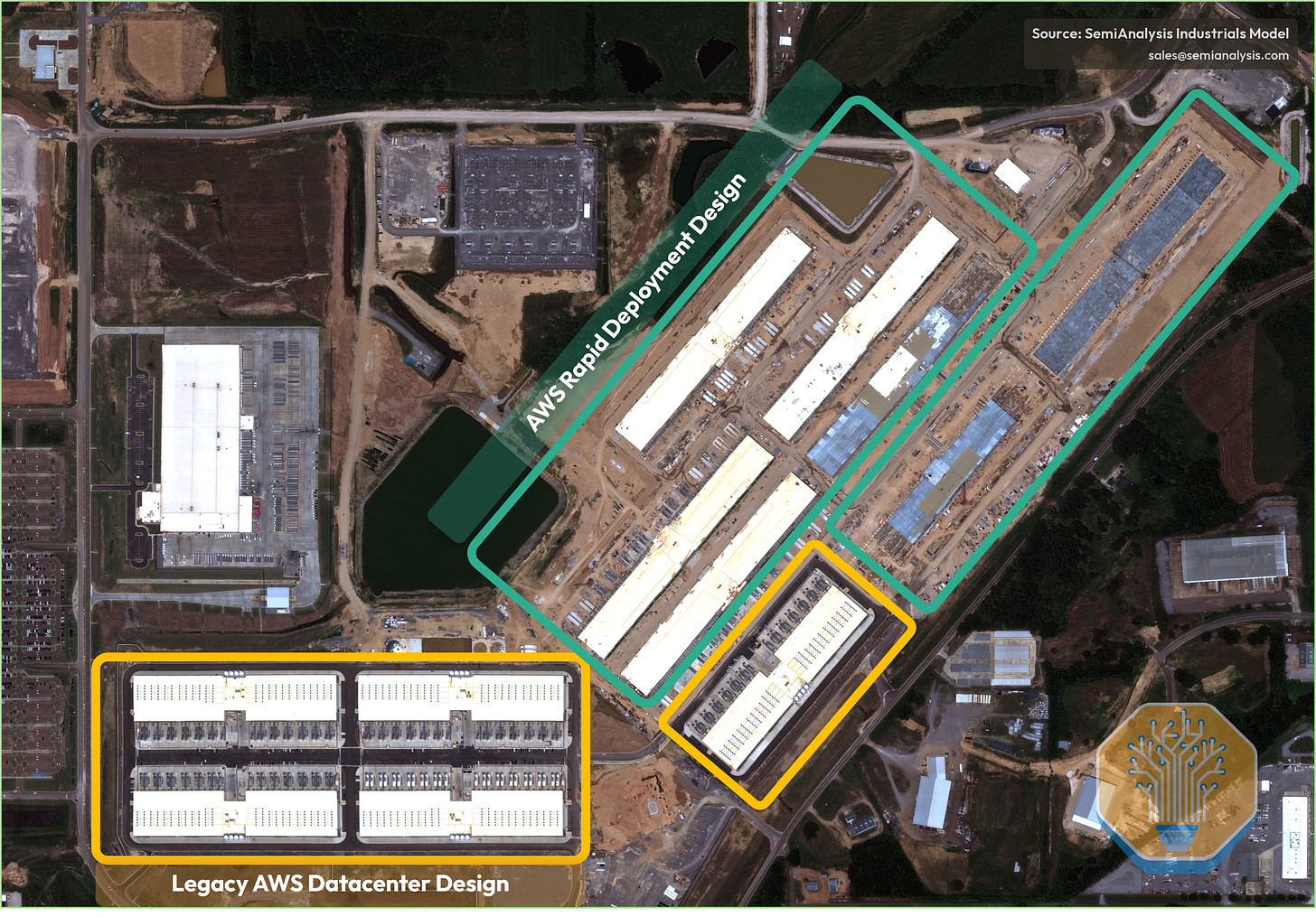
Others have opted for more radical design changes. One example is [Meta with its tent design, that we exclusively unveiled over a year ago](https://newsletter.semianalysis.com/p/meta-superintelligence-leadership-compute-talent-and-data). Another one is AWS which has materially simplified their shell design and launched a new rapid design dubbed “SAMDC”. Data halls are also increasingly prefabricated, an effort called Project Houdini at AWS. Construction timelines are now under 10 months. Hence our “[LEGO Datacenters](https://newsletter.semianalysis.com/p/the-wild-wild-west-of-lego-datacenters)” title for the modular movement, you literally slot them in and go, and doing so allows for MEP labor (7-11 months of work) to drop up to 63%! We will have a full deep dive on the labor of the 2027 buildout coming soon.
_[Source: SemiAnalysis Industrials Model](https://semianalysis.com/industrials-model/)_
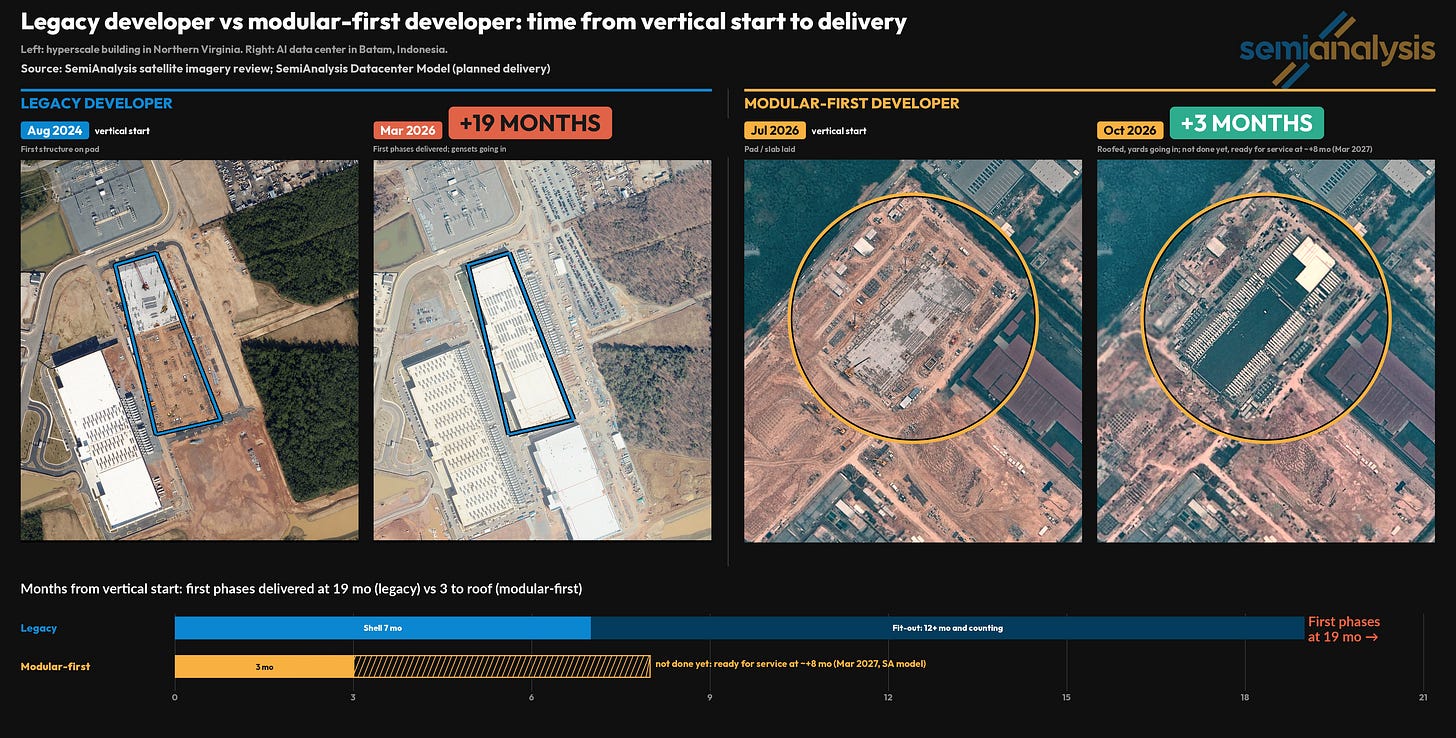
In addition to hyperscale selfbuild, datacenter developers promoting prefabricated designs have also been remarkably successful. DayOne is likely the best example. With a total of ~3GW leased since their first deal in early 2023, the Singaporean company has been a rocket ship in terms of construction speed. While traditional developers have >18 months build timelines, DayOne cut this to ~9 months, which was key to signing huge deals with Firmus, OpenAI and Nvidia.
_[Source: SemiAnalysis Datacenter Industry Model](https://semianalysis.com/datacenter-industry-model/)_
[Subscribe now](https://newsletter.semianalysis.com/subscribe?)
Another core issue is power, and again we think the issue is largely solved. We’ve been the first to talk about all issues on power, [since March 2024](https://newsletter.semianalysis.com/p/ai-datacenter-energy-dilemma-race) and subsequently given the [grid headroom dips negative at the end of 2027](https://newsletter.semianalysis.com/p/us-grid-constraints-towards-40gw). This ended up driving [AI Labs and hyperscalers to build their own power plants](https://newsletter.semianalysis.com/p/how-ai-labs-are-solving-the-power), better known as Behind-the-meter generation, bypassing 5-10year grid interconnection timelines. And while turbine incumbents like GEV quickly faced production bottlenecks, the industry quickly reacted and we’ve since seen a surge in new OEMs and new solutions supplying the market. From fuel cells to truck engines to refurbished turbines, the power generation problem has broadly been solved.
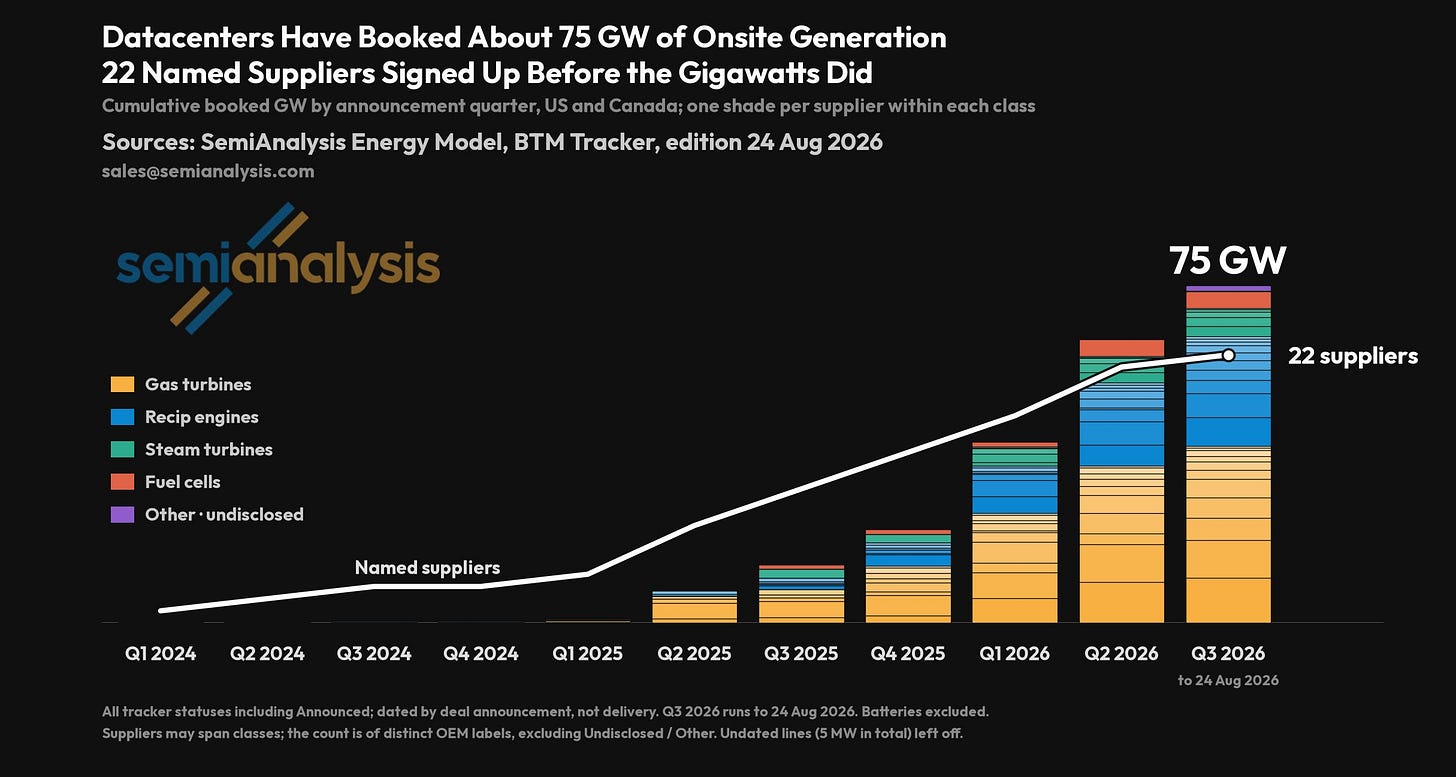
_[Source: SemiAnalysis Energy Model](https://semianalysis.com/energy-model/)_
In addition, the buildout is now geographically diversifying. This naturally bypasses US labor, power, and (in some countries) permitting constraints. And as shown below, the ex-US buildout is sharply accelerating in 2027, and we expect it to gain a lot of market share in 2028, largely driven by US challenges.
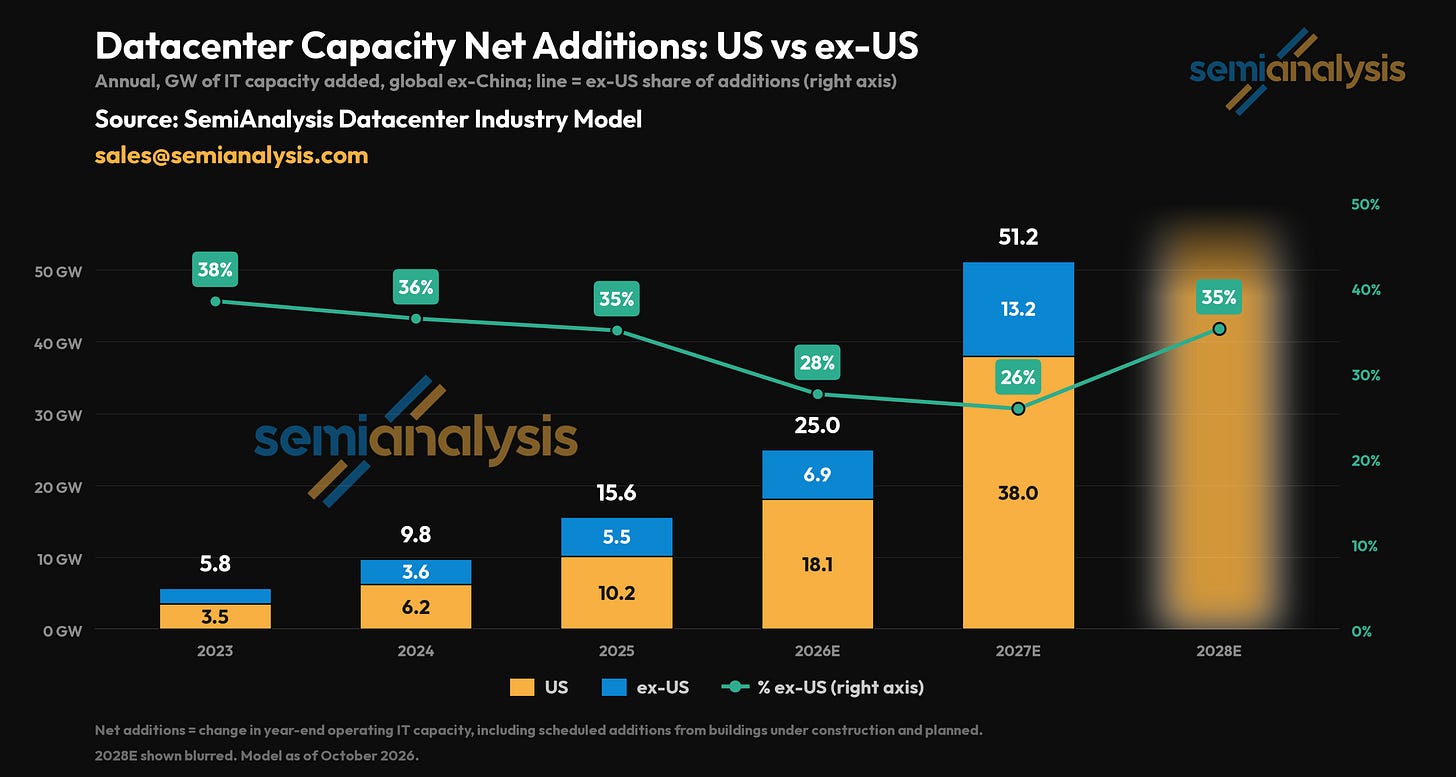
_[Source: SemiAnalysis Datacenter Industry Model](https://semianalysis.com/datacenter-industry-model/)_
# The Real Question: Will We Have an Oversupply of Datacenters?
60GW Under Construction, SemiAnalysis Leading Indicators, 1.3T of Lease Contracts Signed YTD, The Shortage Could Move to Chips
It’s very tempting to cede to the FUD given all the constraints on the datacenter buildout: power, labor, supply chains, capital, and many more. But at SemiAnalysis, we care about the truth, not about narratives. And here’s the truth for you: one picture, >24GW of datacenters in advanced stage of construction, all to be delivered in 2027. Most of them are more than halfway done, with exterior cooling and electrical equipment already installed. That’s just 40 campuses, a tiny share of the multiple hundred sites in advanced stage of construction. We track them all, and for the full granularity, use our [Datacenter Industry Model](https://semianalysis.com/datacenter-industry-model/).

_[Source: SemiAnalysis Datacenter Industry Model](https://semianalysis.com/datacenter-industry-model/)_
Of course, there are plenty of challenges and shortages. Behind these pictures, there are labor issues, supply chain delays, fundraising challenges, among many others. We’ve written in-depth about [Modular Datacenters and Labor](https://newsletter.semianalysis.com/p/the-wild-wild-west-of-lego-datacenters), Datacenter [Electrical](https://newsletter.semianalysis.com/p/datacenter-anatomy-part-1-electrical) systems, [Cooling](https://newsletter.semianalysis.com/p/datacenter-anatomy-part-2-cooling-systems) systems, [Behind-The-Meter power](https://newsletter.semianalysis.com/p/65b2f4e2-b298-4b11-97b1-e40721e15ee5), the [US Grid Constraints](https://newsletter.semianalysis.com/p/us-grid-constraints-towards-40gw), and [Nvidia’s ecosystem financial support](https://newsletter.semianalysis.com/p/nvidias-backstop-universe-heads-i). But the fact is simple: gigantic sites are simply getting built, and many are on time. For example, just go look at what Crusoe built in Abilene, what AWS built in Indiana, or QTS/Microsoft’s giant site in Georgia. These are the sites that have produced SOTA technology like GPT-6 and Fable 5.5. Looking ahead, despite all the constraints, an accelerating number of giant sites keep getting built, as shown by our Top 40 picture

_[Source: SemiAnalysis Datacenter Industry Model](https://semianalysis.com/datacenter-industry-model/)_
If you ask any datacenter builder, they’ll tell you how hard it is, how some workers aren’t showing up, how vendors are delayed, and many other issues. All of this is accurate. And that’s why we’ve successfully called out countless datacenter delays and keep calling out developer timelines that appear overly aggressive in our Datacenter model, including the [Oracle New Mexico Force Majure site delay in April](https://semianalysis.com/datacenter-industry-model/). To be fair, +50GW is essentially the global cumulative datacenter market up through 2024 being built in one year! But our [Datacenter Industry Model](https://semianalysis.com/datacenter-industry-model/) adjusts for all of that and still points to a material acceleration in datacenter capacity in 2027. So, what are we seeing that others can’t?

_[Source: SemiAnalysis Datacenter Industry Model](https://semianalysis.com/datacenter-industry-model/)_
SemiAnalysis is a reader-supported publication. To receive new posts and support our work, consider becoming a subscriber.
**
Let’s dig in. We’ll explore the following topics in this report:
-
SemiAnalysis proprietary leading indicators: we’ll show a sneak peak of our proprietary data supporting our forecast, such as self-build construction starts and datacenter leasing (in MWs and USD). Year-to-date, **slightly under USD 1T of binding / non-cancellable datacenter leases have been signed** – that’s key to supporting our aggressive 2027-28 forecast.
-
The shape of the buildout: how can we support +50GW in a single year? Where, what design, what power solutions?
-
The “real” question: are we going to face a datacenter oversupply? As we explained in [The Great Silicon Shortage](https://newsletter.semianalysis.com/p/the-great-ai-silicon-shortage), datacenters & power may be the tip of the iceberg, with memory and logic possibly becoming the new #1 constraint in 2027-28.
Overall, we are very excited about 2027. The natural implication of the acceleration will be significantly more compute supply. That means cheaper and smarter AI, faster pace of AI model progress, and likely material revenue acceleration for leading AI labs and other token vendors. That also means unthinkable capex numbers. Reflexively rates will have to shoot up to enable the buildouts from a capital demand perspective. Let’s dive in!
# SemiAnalysis Datacenter Leading Indicators: how we see the buildout before everyone else
Today we want to dive into two crucial indicators that give us strong confidence on our 2027 forecast. The first one is quarterly self-build construction starts. To accurately forecast US hyperscalers, we track the exact construction evolution of every single building. And the conclusion is simple: US hyperscalers have never launched more construction of datacenters. Each quarter, we track how many MWs start construction, and that number is going parabolic, driven in particular by two hyperscalers. If you want to know who or track the granularity of our data, subscribe to our [Datacenter Industry Model.](https://semianalysis.com/datacenter-industry-model/)

_[Source: SemiAnalysis Datacenter Industry Model](https://semianalysis.com/datacenter-industry-model/)_
The second indicator is Datacenter Leasing. We’ve talked about this a lot in prior reports, but as a quick recap: given the capital-intensity of building multi hundred MW datacenters, developers typically only spend 5-10% of project capital without a customer. They need a “pre-lease” to fund and develop the whole project. That’s typically a 15-20 year contract, with a TCV of $30-50B per GW. Check out our [HPC Lease Tracker](https://semianalysis.com/datacenter-industry-model/) as part of the [Datacenter Model](https://semianalysis.com/datacenter-industry-model/) to dive into actual contract economics.
[Subscribe now](https://newsletter.semianalysis.com/subscribe?)
As such, tracking these lease contracts is a key leading indicator, as it leads debt raises, which itself leads the actual buildout. A big reason why 2026 datacenter growth isn’t “that” high relative to 2025, is that quarterly datacenter leasing remained relatively stable between H2 2023 and H1 2025. Of course, the key reason was the Microsoft Datacenter Freeze, which we called out before anyone else in December 2024 for [Datacenter model subscribers](https://semianalysis.com/datacenter-industry-model/): the Redmond giant single-handedly drove the leasing market in 2023 and 2024, then paused, and others could only pick up what was left behind.
Since H2 2025, things have dramatically changed. Oracle kicked off the era of gigantic leases, after closing on ~4.5GW of datacenter IT capacity across three sites between August and October 2025. Everyone else followed, and the pool of buyers has never been broader, with Meta, AWS, Microsoft, Google, Nvidia, AMD, Anthropic and OpenAI all being in the market for GW-scale leases. There’s also a long tail of Neoclouds signing hundred-MW-scale deals.
In USD terms, this means an unprecedented amount of lease value that builders can use to raise debt. **Just in 2026 year-to-date, we’ve identified over a trillion USD of lease value that was signed and closed**. That trillion is supporting a gigantic datacenter buildout in 2027-28. Our new [Compute, Capital & Markets Model](https://semianalysis.com/compute-capital-and-markets/) is now tracking all the debt raises and can confirm that most of this debt has been raised.

_[Source: SemiAnalysis Datacenter Industry Model](https://semianalysis.com/datacenter-industry-model/)_
# The shape of the buildout: how to build 50GW in a year
Tracking all of these leading indicators has enabled us to [forecast, before anyone else, the upcoming surge in orders for many industrial suppliers like Vertiv, ABB, Sterling Infrastructure. Check out our Industrials Model for in-depth coverage](https://semianalysis.com/industrials-model/). However, the challenge is now going from orders to delivery. And resources have obviously become constrained, as power, labor, and sheer regulatory overhead are enormous burdens for developers. But the industry has promptly reacted with innovation.
The first step is to simplify datacenter designs. We show below how Google has modularized their electrical architecture, removing a significant amount of outdoors cabling that requires onsite assembly, replacing them with prefabricated electrical modules. We track all the equipment changes (including suppliers) for datacenter designs and forecast orders in our [Industrials Model](https://semianalysis.com/industrials-model/)

_[Source: SemiAnalysis Industrials Model](https://semianalysis.com/industrials-model/)_
Others have opted for more radical design changes. One example is [Meta with its tent design, that we exclusively unveiled over a year ago](https://newsletter.semianalysis.com/p/meta-superintelligence-leadership-compute-talent-and-data). Another one is AWS which has materially simplified their shell design and launched a new rapid design dubbed “SAMDC”. Data halls are also increasingly prefabricated, an effort called Project Houdini at AWS. Construction timelines are now under 10 months. Hence our “[LEGO Datacenters](https://newsletter.semianalysis.com/p/the-wild-wild-west-of-lego-datacenters)” title for the modular movement, you literally slot them in and go, and doing so allows for MEP labor (7-11 months of work) to drop up to 63%! We will have a full deep dive on the labor of the 2027 buildout coming soon.

_[Source: SemiAnalysis Industrials Model](https://semianalysis.com/industrials-model/)_
In addition to hyperscale selfbuild, datacenter developers promoting prefabricated designs have also been remarkably successful. DayOne is likely the best example. With a total of ~3GW leased since their first deal in early 2023, the Singaporean company has been a rocket ship in terms of construction speed. While traditional developers have >18 months build timelines, DayOne cut this to ~9 months, which was key to signing huge deals with Firmus, OpenAI and Nvidia.

_[Source: SemiAnalysis Datacenter Industry Model](https://semianalysis.com/datacenter-industry-model/)_
[Subscribe now](https://newsletter.semianalysis.com/subscribe?)
Another core issue is power, and again we think the issue is largely solved. We’ve been the first to talk about all issues on power, [since March 2024](https://newsletter.semianalysis.com/p/ai-datacenter-energy-dilemma-race) and subsequently given the [grid headroom dips negative at the end of 2027](https://newsletter.semianalysis.com/p/us-grid-constraints-towards-40gw). This ended up driving [AI Labs and hyperscalers to build their own power plants](https://newsletter.semianalysis.com/p/how-ai-labs-are-solving-the-power), better known as Behind-the-meter generation, bypassing 5-10year grid interconnection timelines. And while turbine incumbents like GEV quickly faced production bottlenecks, the industry quickly reacted and we’ve since seen a surge in new OEMs and new solutions supplying the market. From fuel cells to truck engines to refurbished turbines, the power generation problem has broadly been solved.

_[Source: SemiAnalysis Energy Model](https://semianalysis.com/energy-model/)_
In addition, the buildout is now geographically diversifying. This naturally bypasses US labor, power, and (in some countries) permitting constraints. And as shown below, the ex-US buildout is sharply accelerating in 2027, and we expect it to gain a lot of market share in 2028, largely driven by US challenges.

_[Source: SemiAnalysis Datacenter Industry Model](https://semianalysis.com/datacenter-industry-model/)_
# The Real Question: Will We Have an Oversupply of Datacenters?
60GW Under Construction, SemiAnalysis Leading Indicators, 1.3T of Lease Contracts Signed YTD, The Shortage Could Move to Chips
决策记录链 · 只追加
每次领取产生一条记录,重新决策追加一条并以 supersedes 指向被替代的记录(ADR 0014)。
64b4bd68e1· 2026-10-19 15:51 · doubao / doubao-seed-evolving-latest-version · 策略包658c0c1e2ba5当前